
- Contents
A GeoPoll survey of 1,349 Kenyans, fielded as news of the country’s first confirmed Ebola case broke, shows near-universal concern but uneven knowledge of what to do.
On 6 October 2026, Kenya’s Ministry of Health confirmed the country’s first Ebola case. The patient, a Kenyan national who had lived in the Democratic Republic of the Congo (DRC), traveled to Nairobi through Uganda and passed away while undergoing treatment in a hospital in Nairobi. Health authorities quarantined family members and health workers who had contact with the patient and began tracing passengers from the flight.
The case is linked to the Ebola epidemic in the DRC, which began in May 2026 and has since become the worst in that country’s history, with more than 8,300 confirmed cases and over 4,000 deaths reported by early October. The World Health Organization (WHO) declared the outbreak a Public Health Emergency of International Concern in May 2026. GeoPoll has been conducting Ebola KAP surveys in the DRC for the last few months.
To understand how Kenyans are reacting, GeoPoll ran a rapid mobile survey on 6 and 7 October 2026, collecting 1,349 completed responses from adults in 46 of Kenya’s 47 counties. The survey covered awareness, concern, knowledge of symptoms, trust in information sources and exposure to misinformation.
Most Kenyans heard about the case within a day
Nearly three in four respondents (73%) said they had already heard about the Ebola case in Kenya. Another 23% had not, and 4% were not sure. Most people heard through news coverage, social media and television, with very few citing friends, family or health officials as their first source.
Concern is close to universal
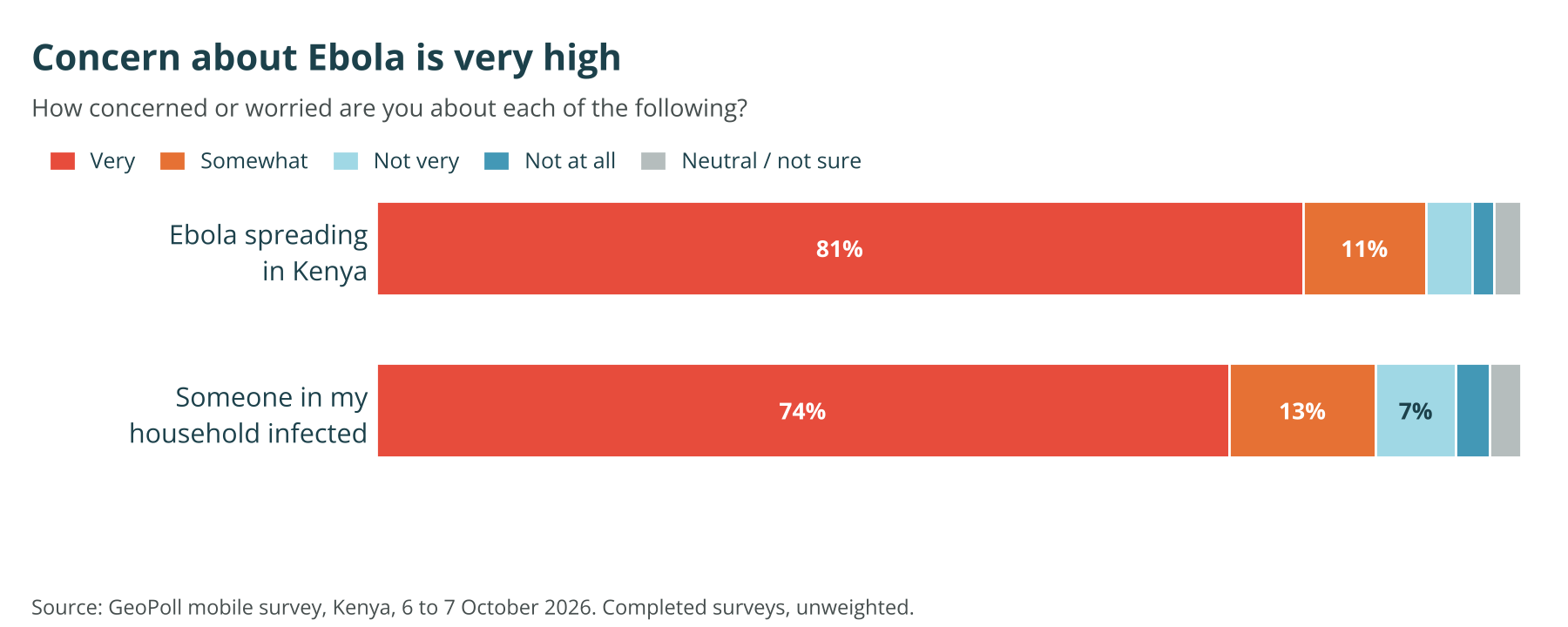
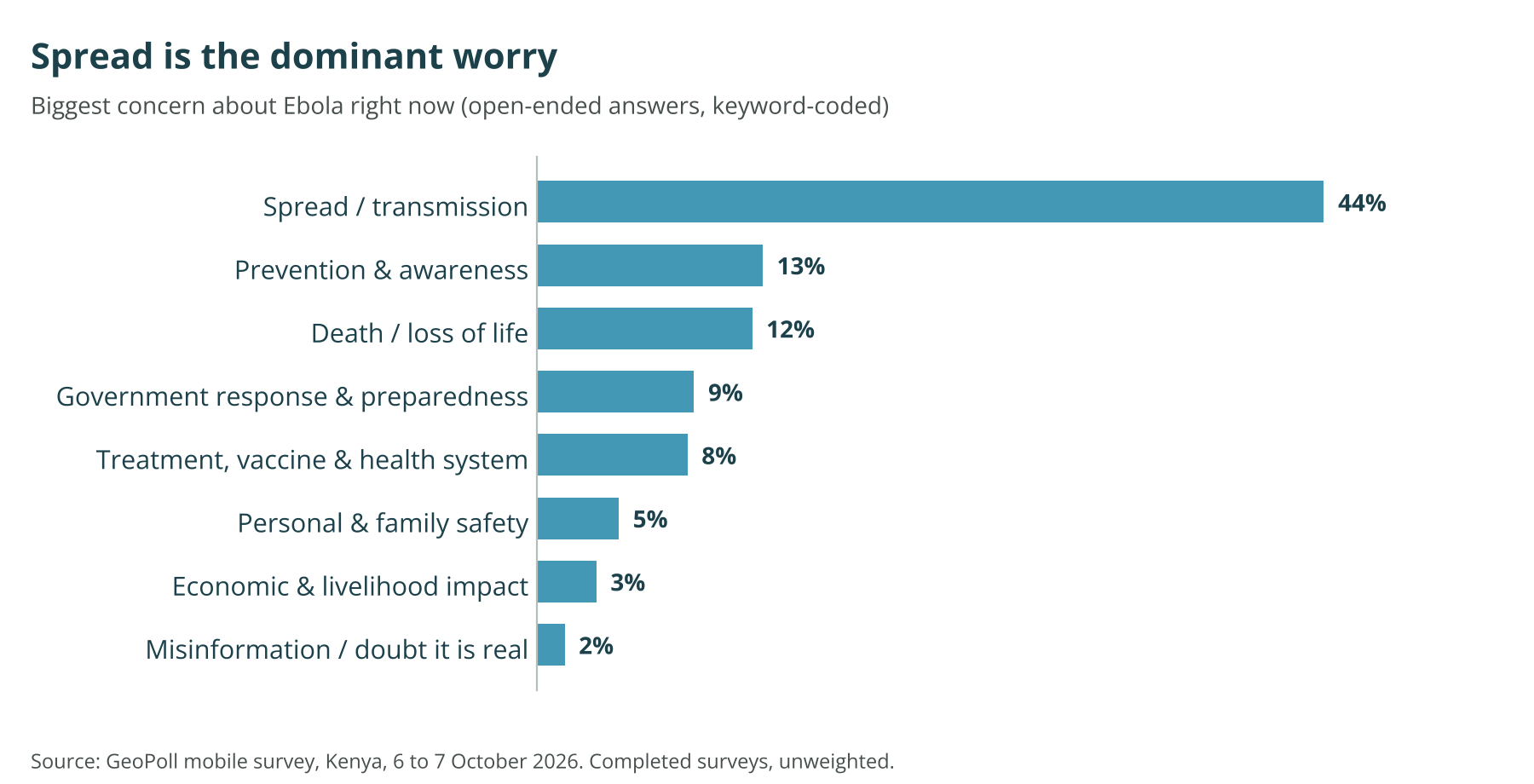
Concern is very high. 81% of respondents are very concerned about Ebola spreading in Kenya, and 92% are at least somewhat concerned. Worry is personal as well: 74% are very worried that they or someone in their household could become infected.
Knowledge of symptoms is partial
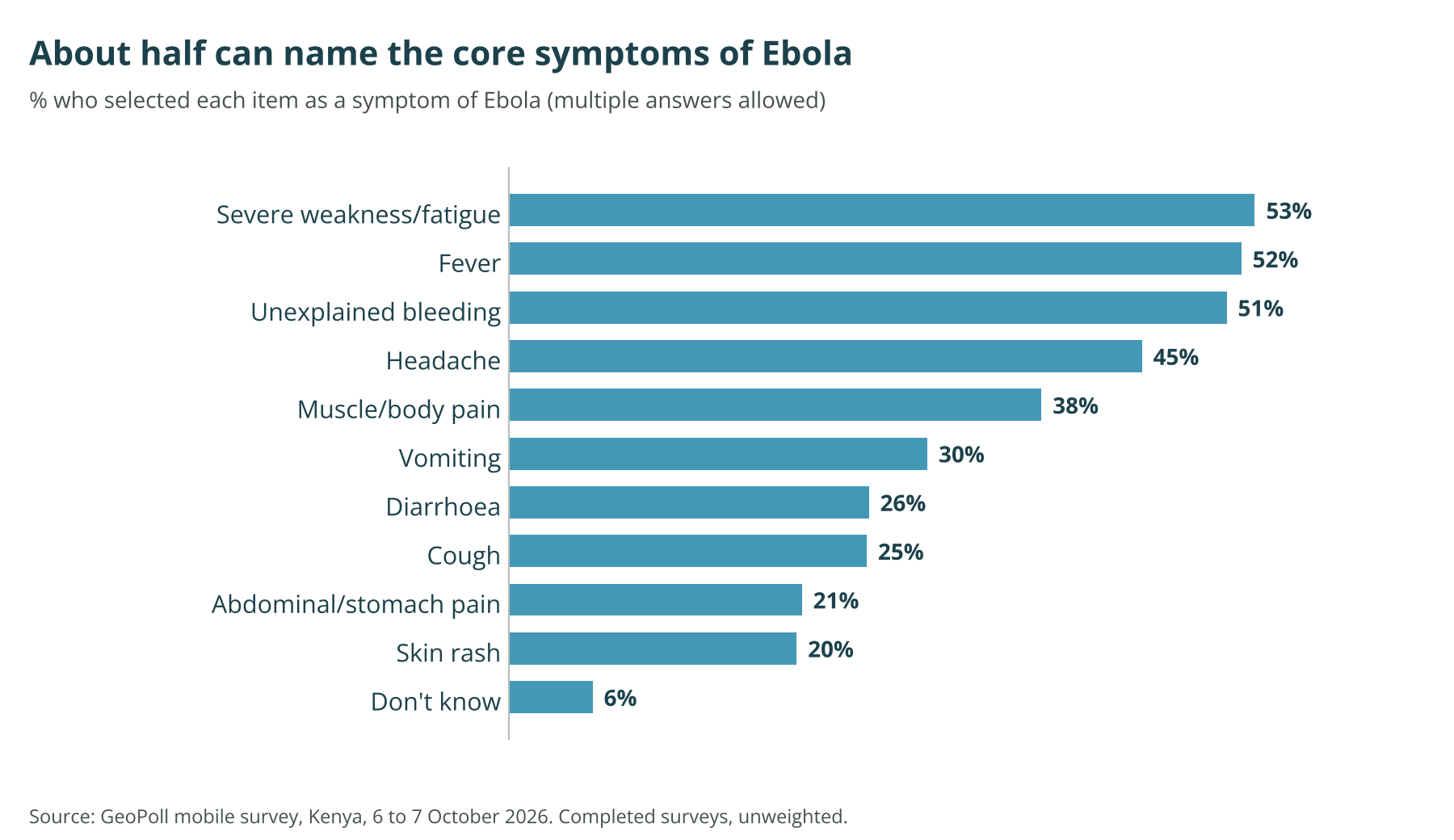
Only about half of respondents identified the core early symptoms of Ebola. 53% selected severe weakness or fatigue, 52% fever and 45% headache. Fewer recognised vomiting (30%), diarrhoea (26%) or abdominal pain (21%), which WHO lists among the symptoms that typically follow. Half (51%) named unexplained bleeding, which occurs in some cases but usually later in the illness. 6% said they did not know any symptoms.
A preparedness gap
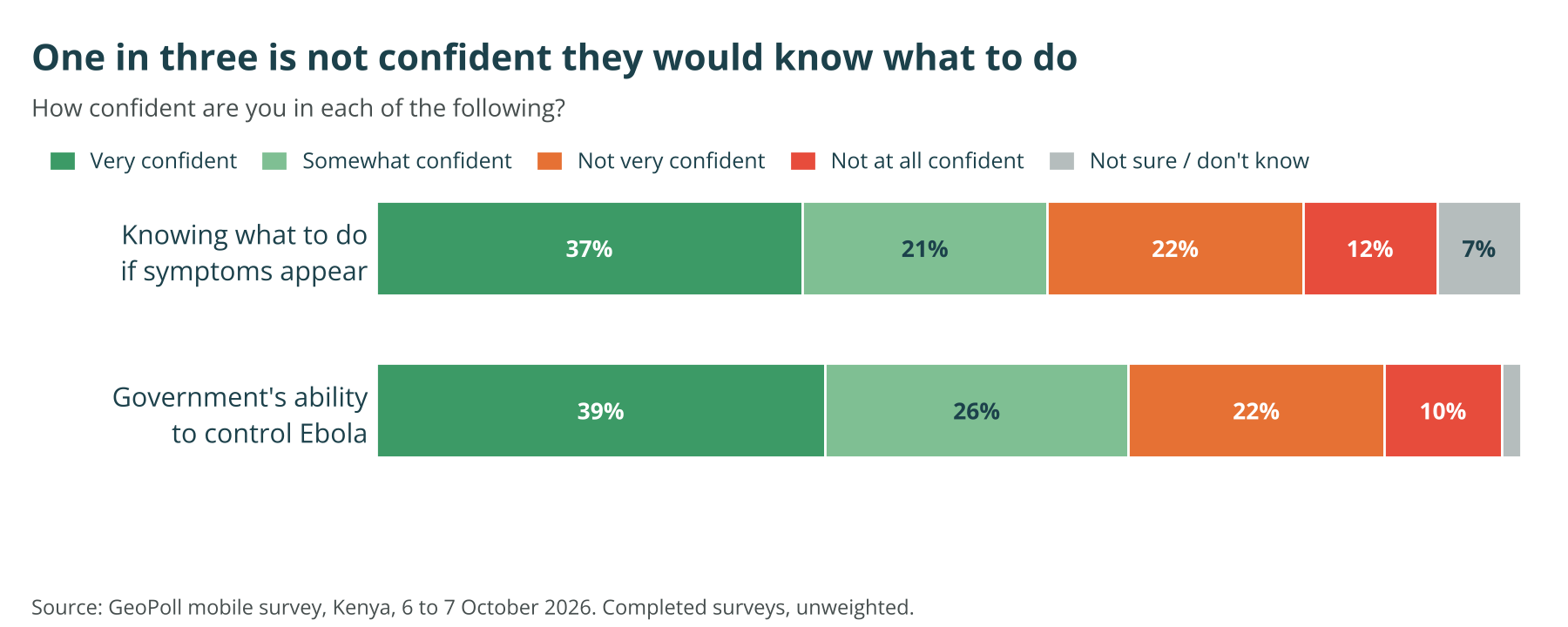
High concern does not translate into confidence about what to do. 37% are very confident they would know what to do if they or someone close to them developed symptoms. One in three (34%) is not confident, and 7% are not sure. Confidence in the government is somewhat higher: 66% are confident in the Kenyan Government’s ability to prevent and control the spread of Ebola, while 33% are not.
Official sources are trusted, but doubt persists
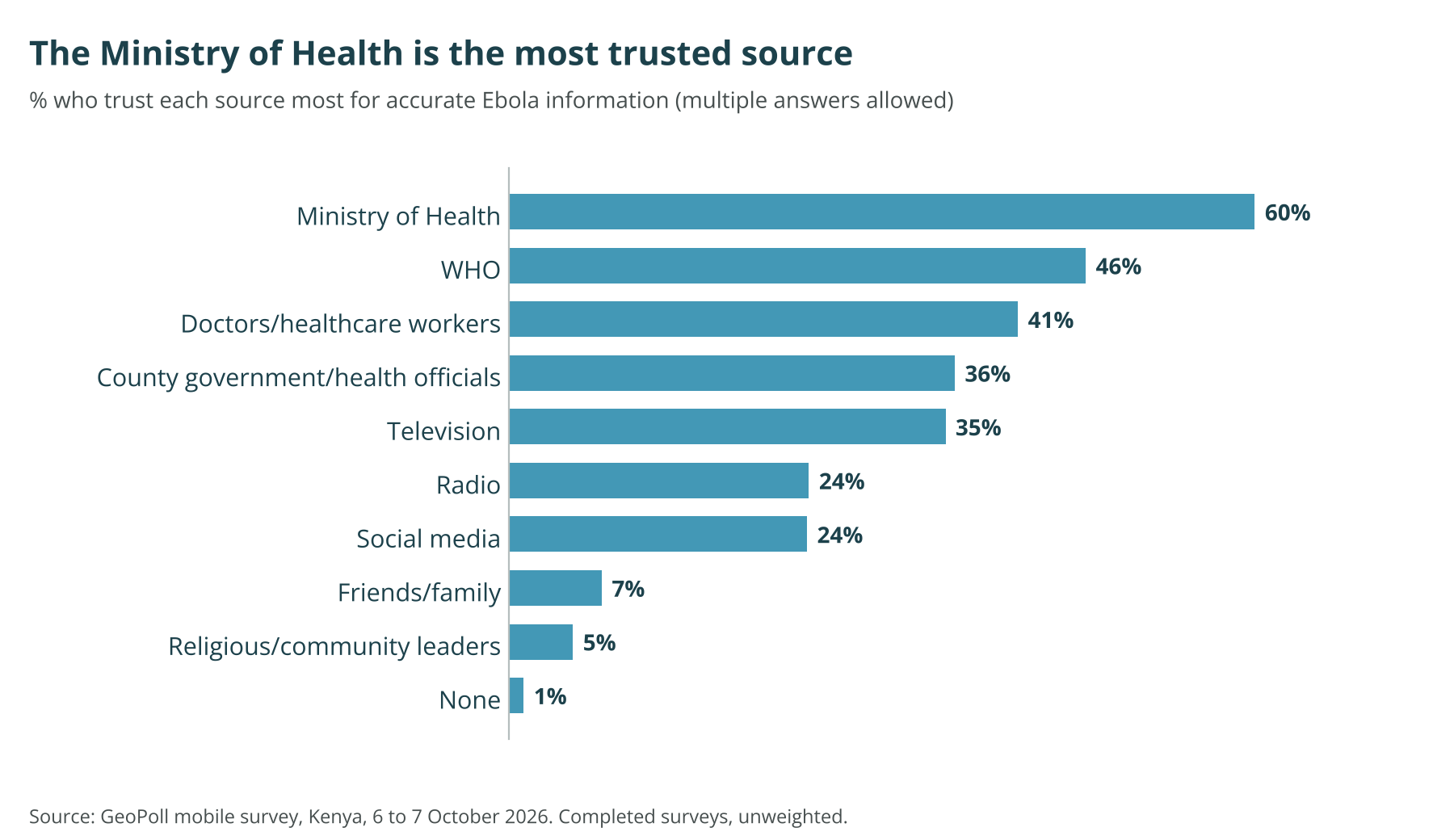
The Ministry of Health is the most trusted source of accurate Ebola information, selected by 60% of respondents. WHO (46%), doctors and healthcare workers (41%) and county health officials (36%) follow. Television (35%) ranks above radio and social media (24% each).
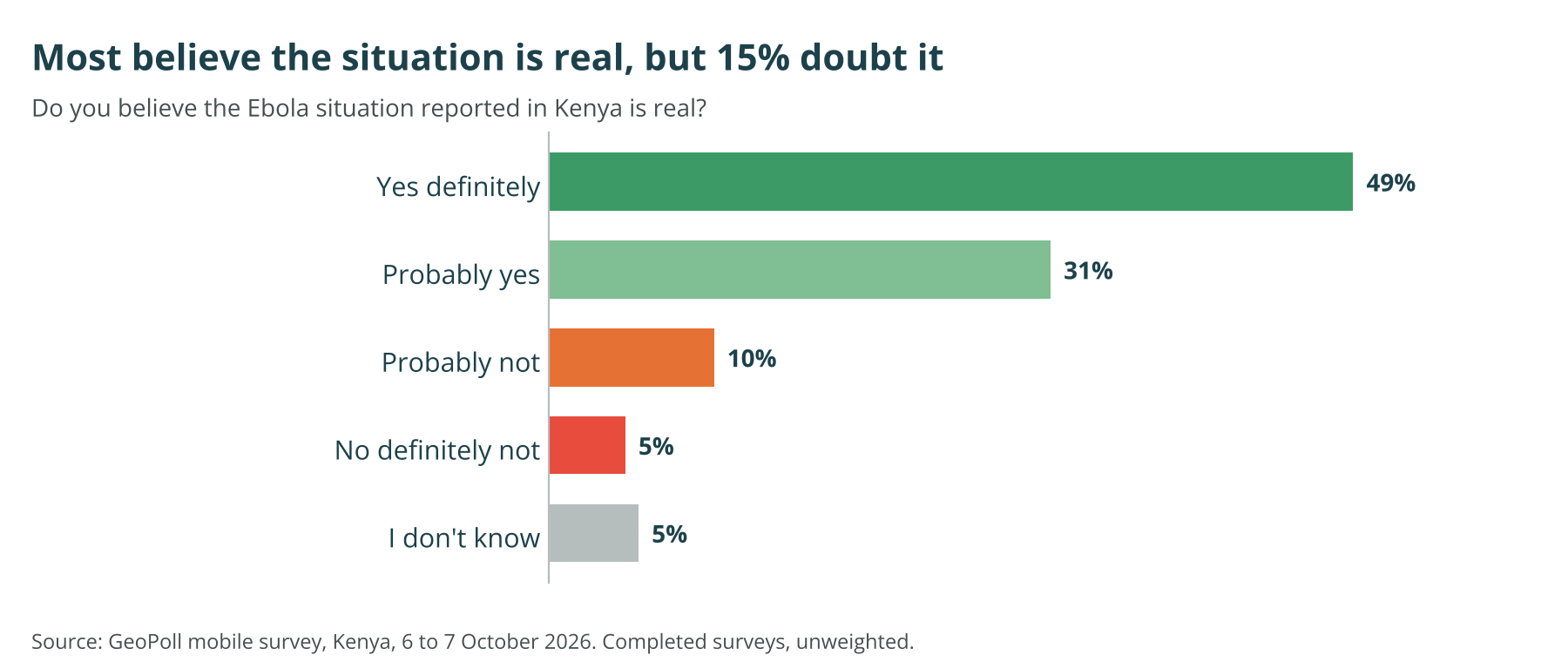
Most respondents (80%) believe the reported Ebola situation is real. However, 15% think it is probably or definitely not real, and 5% do not know. This minority matters during an outbreak, because people who doubt the threat are less likely to follow guidance or report symptoms.
Half have already seen misinformation
About half, 52% of respondents said they have seen information about Ebola in Kenya that they believe may be false or misleading. 23% see it frequently. Among those who encountered it, television was the most common channel (29%), followed by Facebook (25%), TikTok (16%) and X/Twitter (10%). Taken together, social platforms account for 57% of these encounters.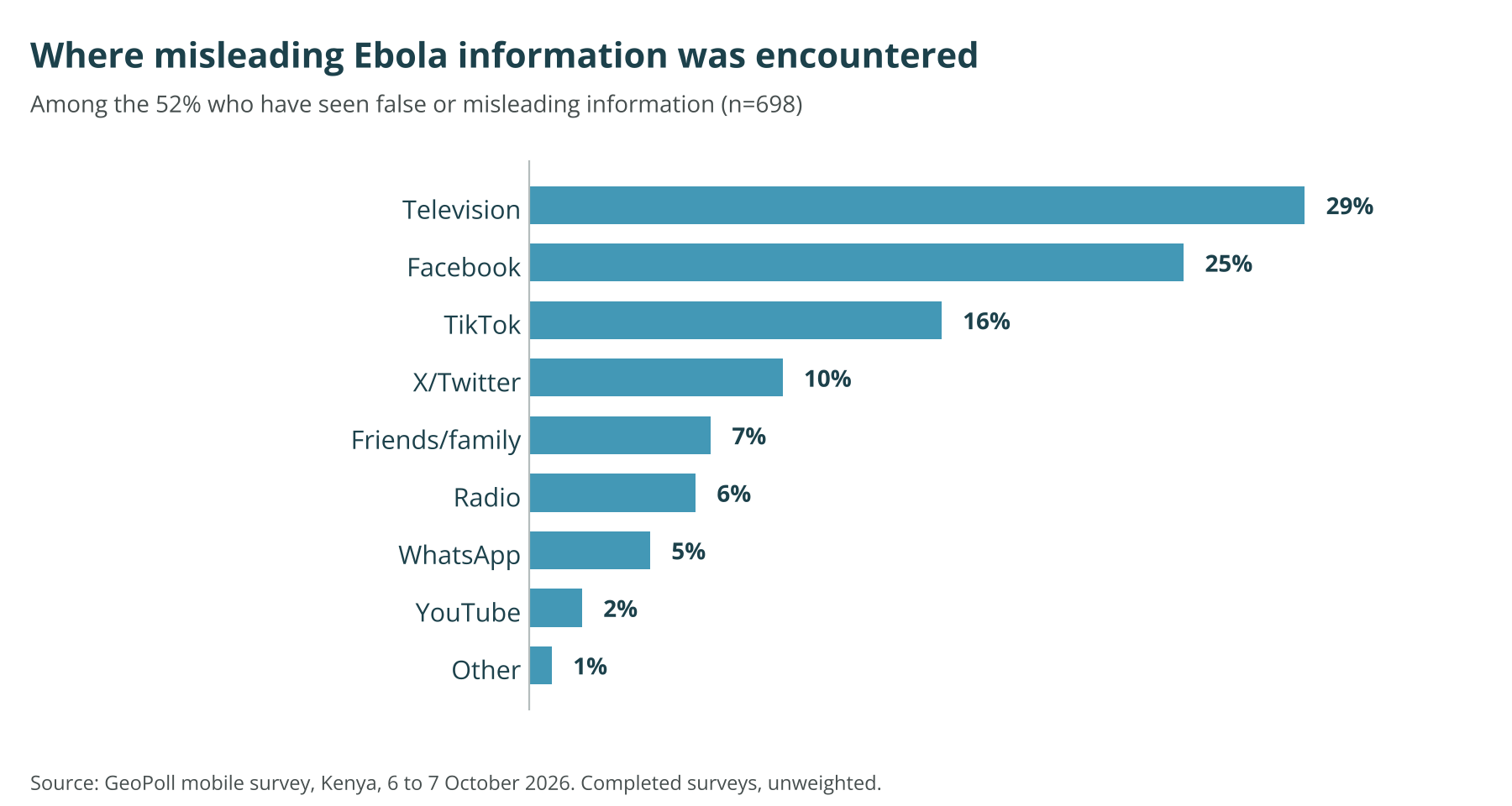
What this means
- Practical guidance is the priority. Concern is already high, so communication should focus on what to do: which symptoms to watch for, who to call and where to go.
- Use the channels people trust. The Ministry of Health holds the highest trust. Its verified channels, including the JALI WhatsApp chatbot (0700 719 719), are well placed to reach people directly.
- Address doubt early. One in seven respondents questions whether the situation is real. Clear, consistent updates from health authorities can limit the space for rumours.
- Monitor misinformation across media. Misleading content is reaching people through both television and social platforms, so fact-checking efforts need to cover both.
- GeoPoll has the tools and panels to conduct this type of research quickly, affordably, and safely (remotely). The process from questionnaire development to data collection to reporting took less than 24 hours, and because of the modes and panels used, we achieved a modest Cost per Interview of $0.10.
GeoPoll conducted this rapid dipstick survey through its mobile platform between 6 and 7 October 2026. The results combine two waves of the same questionnaire, yielding 1,349 completed interviews with adults aged 18 and over across 46 of Kenya’s 47 counties. The results are unweighted and reflect a natural fall-out sample rather than strict demographic quotas. The sample is skewed male, younger, and more educated than the national population. As a result, the findings should be considered indicative of mobile-connected adults and should not be interpreted as nationally representative of Kenya’s adult population. For health research, including studies on public health, health behaviours, awareness, attitudes, and access to healthcare across Africa, Asia, and Latin America please contact GeoPoll.