
- Contents
As the United Nations prepares to select its 10th Secretary-General, the UN Foundation turned to GeoPoll to answer a fundamental question: what does the world actually think about the UN, and what do people want from its next leader?
The result is A Mandate for Renewal: Global Public Opinion on the United Nations and the Selection of the 10th Secretary-General, a 20-country study fielded between September 1 and 16, 2026. GeoPoll led the fieldwork, surveying 5,000 respondents across all 15 members of the UN Security Council plus five additional major nations, together representing 4.5 billion people, or 56% of the world’s population.
Why this study mattered
Polling public opinion around a UN Secretary-General selection at this scale had not been done before. It required reaching respondents across P5 nations, elected Council members, and non-Council powers, in 15 languages, using a mix of mobile web and computer-assisted telephone interviewing where connectivity required it.
In the DRC, Liberia, and Somalia, GeoPoll’s in-country CATI teams conducted interviews in French, Lingala, English, and Somali, helping ensure that lower-connectivity markets were represented rather than left out. That is the kind of problem-solving GeoPoll takes on every day across hard-to-reach markets.
What the data shows
A few findings stand out:
- People are anxious but not isolationist. 57% of respondents are worried about the future, yet nearly 90% agree that even powerful nations need international partnerships to address global threats.
- The UN remains broadly seen as necessary. 84% see the UN as necessary, but 52% say it is struggling to deliver results. Only 10% want it to keep operating exactly as it does now.
- Citizens want an outward-facing Secretary-General. Respondents split fairly evenly between wanting a diplomat (28%), a crisis manager (26%), and a moral voice (25%), with less appetite for an internal reformer (17%).
- There is substantial support for a woman as the next Secretary-General. 61% believe it is important that the 10th Secretary-General be a woman, a view shared most strongly by women, younger adults, and Global South respondents.
- The selection process remains largely invisible to the public. 85% have heard little or nothing about it, and candidate name recognition averages just 19%.
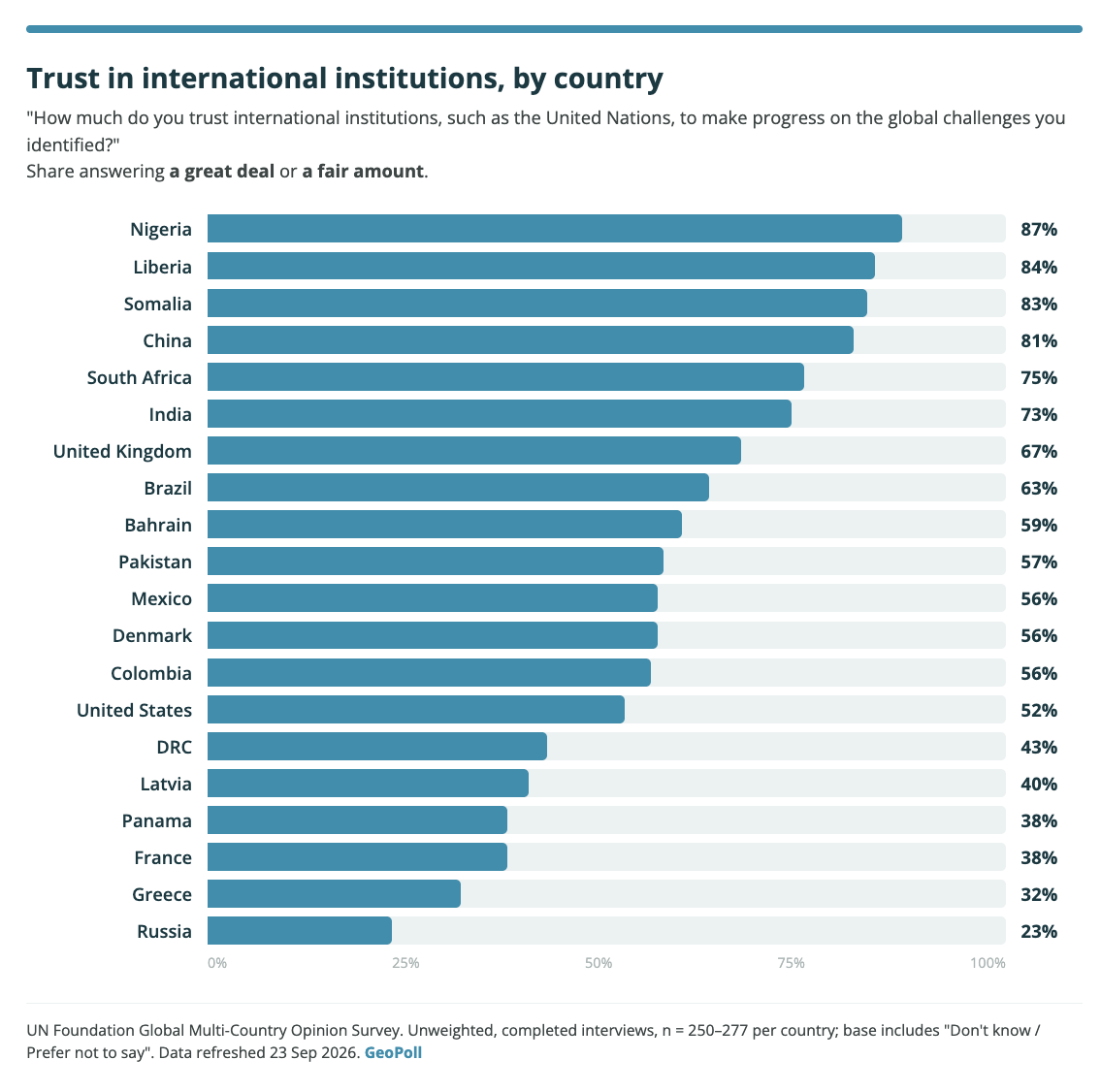
- Trust in international institutions varies considerably by country and region. Trust stands at 58% globally and is notably higher in the Global South (65%) than the Global North (44%).
Behind the 58% global figure sits a 64-point gap between the most and least trusting countries. When asked how much they trust international institutions such as the United Nations to make progress on global challenges, 87% of respondents in Nigeria said a great deal or a fair amount, followed by Liberia (84%), Somalia (83%), and China (81%). South Africa (75%) and India (73%) also ranked above the global average.
Trust was lower in parts of Europe and the Americas, with Russia (23%), Greece (32%), France (38%), and Panama (38%) recording the lowest levels among the countries surveyed. The United States (52%) and the United Kingdom (67%) fell in between. The DRC stands out as an exception among the African markets surveyed, with 43% expressing trust.
These differences demonstrate why country-level findings matter alongside global and regional averages, particularly as the next Secretary-General considers how to build confidence in the UN across different parts of the world.
Delivering data that governments and institutions can act on
This project reflects what GeoPoll does across Africa, Asia, and Latin America every day: building nationally and regionally relevant samples in markets that are often excluded from global polling, and delivering data that stands up to scrutiny at scale.
The methodology is documented transparently in the report’s annex, including sample sizes, margins of error, and the limitations of nonprobability sampling in each market. That transparency about what the data can and cannot tell us is central to how GeoPoll approaches every study.
As the Security Council moves toward a final decision, this research provides the incoming Secretary-General with something rare at this stage: a current, global picture of what the people the UN ultimately serves expect from their next leader.
Read the Full Report
Explore the full findings, methodology, and country-level results in the UN Foundation’s report: